Showing posts with label music. Show all posts

Wednesday, April 15, 2009

Frank Zappa spotted it before Apple


In the next meeting with a client or a design neophyte, refrain yourself from using the overused quote "people want a hole in the wall, not a drill". Every single marketing student has learned it and repeated it ad nauseam. Better than that, you can use a quote from the visionary Frank Zappa:

"Music consumers like to consume music... not pieces of vinyl wrapped in pieces of cardboard."


Back in 1983 he already identified the motivations of people for buying music beyond the artifact itself (accessibility to a virtually infinite catalogue and playable from multiple devices with no physical limits) and triggered him to propose a system 'where you could subscribe to whatever genre of music you wanted and get it delivered in batches' which sounds a lot like iTunes music store but many years ago:

"We propose to acquire the rights to digitally duplicate and store THE BEST of every record company's difficult-to-move Quality Catalog Items [Q.C.I.], store them in a central processing location, and have them accessible by phone or cable TV, directly patchable into the user's home taping appliances, with the option of direct digital-to-digital transfer to F-1 (SONY consumer level digital tape encoder), Beta Hi-Fi, or ordinary analog cassette (requiring the installation of a rentable D-A converter in the phone itself . . . the main chip is about $12)."


Wednesday, October 22, 2008

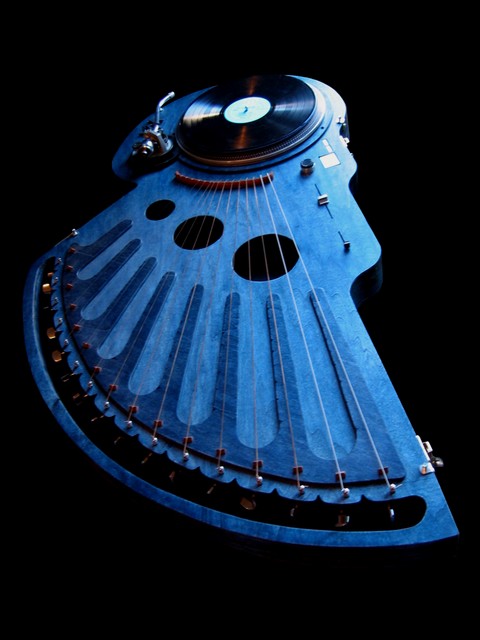
Walter Kitundu and instrument innovation

"I don't have a background in woodwork. I don't have a background in music. I just have a background in trying" Walter Kitundu

Nowadays we are used to see new and innovative musical instruments coming out from digital technology - think synthesizers, sound modules, samplers, etc. All very polished, very perfected, and with thousands of features to master if we want to take full advantage of its power.

What we are not so used to see is the creation of new musical instruments that come from a fresh mechanical remix of parts and acoustic principles of existing instruments. Enter the 'phonoharp': a mix of turntable, harp, dj mixer, resonance box, and analogue drum box.

It would take longer to try to describe how it sounds when it is played than to just hear Mr Kitundu playing this new breed of postmodern instrument. Not surprisingly, just a month ago the MacArthur foundation has awarded him one of its presitgious fellowships together with a half a milion dollars that will surely help him experiment with larger and more complex instruments that he has already sketched in his mind. Stay tuned.

Walter Kitundu demonstrating the PhonoKora
A KQED story on Walter Kitundu

Friday, August 22, 2008

(back to the) life in the woods

No. I am not suggesting that anyone should spend two years by himself in the middle of a thick forest. The only thing I am saying is that lately I have been detecting more and more signs that indicate our culture is going back to our most primitive roots (obviously I am not taking into account the hyped eco-sustainability trend that everybody is trying to embrace, either because of fashion or money)

An example of this contemporary return is the eclectic Kimmo Pohjonen, a Finish artist who hacked an accordion with midi capabilities and delivers an astounding show of Earth Machine Music, a mix of avant-garde, folk, and natural roots :

"Finnish accordion adventurist Kimmo Pohjonen’s singular mission is to expand the capabilities, sound, scope, performance and experience of the accordion to levels never before attempted, seen or heard. Accordion, voice, effects, surround sound and light show combine to make a unique and captivating performance event.A visionary of boundless energy, Pohjonen’s roots go back thirty years in all forms of accordion music including folk, dance, classical, rock, experimental, theatre music and more."
Watch or listen by yourself Kimmo's sounds.

Saturday, June 7, 2008

In-store cozy contextual experiences


Situation
  • Aquarius records, a record store in San Francisco, has been regularly scheduling almost weekly free in-store concerts of bands that are touring the area or just happen to pass by the Bay Area. In most cases, these bands already have a concert in traditional venues in town, but somehow they feel like offering another, more intimate, type of concert that allows them to experiment and play without the pressure of a traditional concert. [via Aquarius mailing list]
  • Stupido, a record label and store in Helsinki Finland, also organizes free concerts in-store for followers of alternative Finish music. [via Monocle]
  • At a corporate level, Apple stores have a consistent program of workshops and events related or not to their products. The store's auditorium can host anything from a live performance of a band to a Photoshop tutorial, and are offered for free.

Significance
  • Now that recorded music is virtually 'free' and people are listening to more music than ever, the live music industry is expending beyond big arenas for superstars and small venues for alternative bands
  • Traditional events-only venues can't rival in terms of intimacy, context, and relevance with music stores where workers are more accessible, the experience is unique and, most importantly for 'the youth of today', costs nothing
Suspicion
  • What other industries are already following or will follow the same practice of bringing the core of a 'product' closer to its consumers in a more suited environment?
  • When will the major record labels start investing in small venues and offer boutique concerts of their multimillion dollar artists to offset the declining revenue of selling plastic?